
 English
  Deutsch
  Português
  Español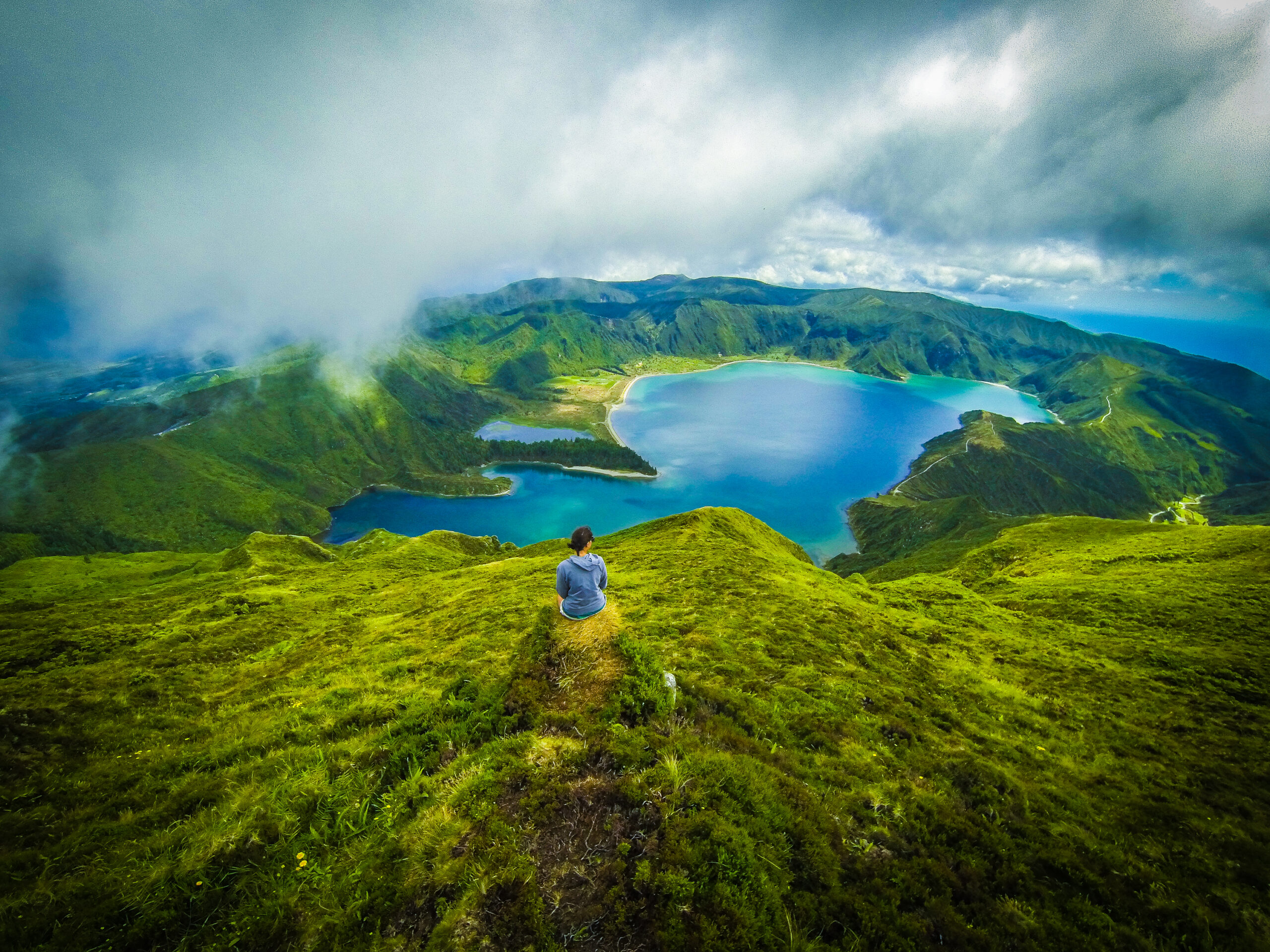
Volcanoes are an indelible mark on the Azorean landscape, especially on the island of São Miguel. Although most are dormant or have little activity, there are several volcanic sites that can be visited on this island of enormous natural beauty. Some of the most beautiful and important lagoons of São Miguel are located in the island’s volcanic complexes or systems.
1st stop – Gruta do Carvão
Located in the western part of the city of Ponta Delgada, in a region of the island of São Miguel geologically known as the “Picos Volcanic Complex,” Gruta do Carvão currently has a length of 1,912 meters divided into three sections, one to the north (Paím section) with a length of 880.2 meters, an intermediate section (Troço dos Secadores de Tabaco, Rua de Lisboa) with a length of 701.8 meters, and one to the south (Troço João do Rego) with a length of 300 meters.
However, old documents and field observations indicate a much larger size than is currently known, possibly reaching dimensions of around 5 km in length, from the coast to the vicinity of Serra Gorda, in Arrifes. For information and reservations, visit http://grutadocarvao.amigosdosacores.pt
2nd stop – Lagoa do Fogo
This lagoon is part of the volcanic massif of the Água de Pau mountain range, located in the central area of the island of São Miguel. Lagoa do Fogo is surrounded by dense and lush endemic vegetation and has very blue waters, which give it a unique beauty.
Covering an area of 1,360 hectares, the volcanic caldera, like the volcano that created it, is the youngest on the island of São Miguel, believed to have formed around 15,000 years ago. Its current configuration is the result of the last collapse, which occurred approximately 5,000 years ago. The last eruption took place in 1563.
It is the highest lake on the island of São Miguel – 949 meters – and its walls have slopes of up to 300 meters. The maximum depth of the lake is 30 meters. Around its perimeter are several species of endemic plants, such as cedar, laurel, heather, and sanguinho.
3rd stop – Lagoa das Furnas
In the Caldeira das Furnas area, you will find Lagoa das Furnas and other manifestations of secondary volcanism, such as fumarolic fields and thermal springs. On the southern shore of the lagoon are the holes where cozido das Furnas (Furnas stew) is cooked using the steam that rises from the volcanic soil. Its unique and unmistakable flavor has made it a world-famous dish, attracting thousands of tourists from all corners of the globe to Furnas every week.
4th stop – Parish of Furnas
The parish of Furnas, established in 1791 and currently with 1,439 inhabitants, is one of the most beautiful locations in the Azores archipelago, commonly known as the “Visiting Room of the Azores.” Its name is related to the secondary volcanic phenomena existing in the Furnas Valley, called fumaroles or “caldeiras.”
However, some say that the greatest wealth of the Furnas Valley lies in the diversity of the mineral and thermal waters of its springs, considered by experts to be the largest hydropole in the world. These justified the construction of public and private thermal water bathing facilities due to their therapeutic function, which were once a great attraction for the cure of diseases.
5th stop – Sete Cidades
The Sete Cidades caldera has a diameter of approximately 5 km and a depth of 400 m. The highest point of the volcano is 845 m above sea level.
Its edges, known as Cumeeiras das Sete Cidades (large and small), serve as a walking trail that circles the peaks of the Sete Cidades caldera, one of the largest volcanic calderas in the Azores, with four interconnected lakes inside it – Lagoa de Santiago, Lagoa Rasa, Lagoa Azul, and Lagoa Verde. The latter are the main tourist attraction of the Azores and one of the 7 natural wonders of Portugal in the category of non-marine aquatic areas.
Behind the colors that give the lakes their names lies the famous legend of Sete Cidades about the love between a blue-eyed princess and a green-eyed shepherd, but in reality, the difference in colors is due to the fact that Lagoa Verde has steeper slopes and therefore reflects more of the surrounding vegetation, while Lagoa Azul, being larger, reflects more of the sky.
sources: visitazores.com | visitpontadelgada.pt | cm-povoacao.pt | grutadocarvao.amigosdosacores.pt